Do You Really Need a Defibrillator at Home? Here's the Truth!

Let's talk about something most Aussie families don't think about until it's too late: what happens when someone has a cardiac arrest at home?
You might assume that calling Triple Zero (000) is enough. And while our ambos are absolutely incredible, here's the sobering truth: 80% of out-of-hospital cardiac arrests happen at home, and right now, only 1 in 10 people survive.
But here's where it gets interesting (and hopeful): if someone receives defibrillation within 3 minutes, survival rates jump to over 70%. That's a massive difference, and it all comes down to one question: do you have the right tools at home to bridge that critical gap before help arrives?
So, do you REALLY need a defibrillator at home? Let's break it down.
The Reality of Cardiac Arrests at Home
Most of us think cardiac emergencies happen to strangers in public places, at the footy, the shopping centre, or the gym. But the statistics tell a different story.
The majority of cardiac arrests happen in the one place we feel safest: our homes.
And here's the kicker: survival rates at home are significantly lower than in public settings. Why? Because most homes don't have immediate access to a defibrillator, and every minute without defibrillation reduces survival chances by 7-10%.
Think about your own home for a second. If your partner, parent, or child collapsed from sudden cardiac arrest right now, what would you do? You'd call 000, start CPR if you know how, and then... wait. Those minutes waiting for the ambulance can be the difference between life and death.
Who Should Consider a Home Defibrillator?
Not every household needs a defibrillator, but many Australian families would benefit enormously from having one on hand. Here's who should seriously consider it:
High-Risk Households
Families with a history of heart disease – if cardiac conditions run in your family, the risk is elevated
Homes with elderly family members – age increases the likelihood of cardiac events
Anyone with a known heart condition – previous heart attacks, arrhythmias, or other cardiac issues
Families living in remote or rural areas – where ambulance response times can stretch beyond the critical 3-minute window
Active Families
If your household is always on the go, backyard cricket, weekend hikes, home gyms, having a defibrillator means you're prepared for the unexpected. Cardiac arrest doesn't just happen to the elderly; it can strike anyone, anytime.
Multi-Generational Homes
More Aussie families are living together across generations. If you've got grandparents, parents, and kids under one roof, a home defibrillator offers peace of mind for everyone.
Meet the Mindray C1: Your 'Doctor in a Box'
When it comes to choosing a defibrillator for your home, you want something reliable, easy to use, and designed for real-life emergencies. That's where the Mindray C1 Defibrillator comes in, we call it the 'Doctor in a Box' for good reason.
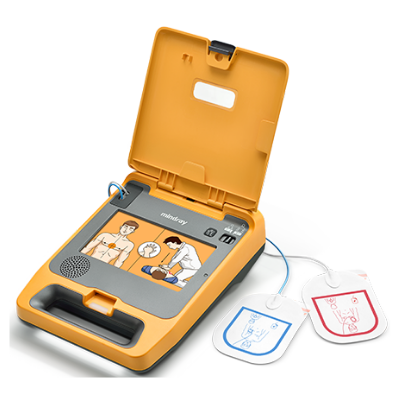
Get your Defib and accessories
Be READY and ABLE to save a life in case of a cardiac arrest out-of-hospital.
Action Now - Get your defibrillator from Heart Safe Australia
Why the Mindray C1 is Perfect for Australian Homes
Fast Shock Delivery
The Mindray C1 delivers a shock in record time, which is crucial when every second counts. It's designed to be intuitive, with clear voice prompts that guide you through each step, even if you've never used one before.
Paediatric Switch
One of the standout features? The built-in paediatric mode. With a simple switch, the device adjusts for children under 8 years old or weighing less than 25kg. You don't need separate pads or equipment, it's all in one unit.
Long Battery and Pad Life
The last thing you want in an emergency is a flat battery or expired pads. The Mindray C1 offers an extended battery life and long-lasting electrode pads, so you can have confidence it'll work when you need it most.
Durable and Reliable
Built to withstand the Australian climate, the Mindray C1 is water and dust resistant. Whether you're in the tropics or the outback, it's ready to perform.
The 3-Steps to Save a Life
Having a defibrillator at home is only part of the equation. You also need to know HOW to use it. The good news? It's simpler than you think.
We teach the 3-Steps to Save a Life in all our Heart Safe programs, and they apply perfectly to home emergencies:
Step 1: Call for Help
Ring Triple Zero (000) immediately. The sooner emergency services are on their way, the better.
Step 2: Start CPR
If the person is unresponsive and not breathing normally, start chest compressions. Push hard and fast in the centre of the chest, about 100-120 compressions per minute. Don't worry about doing it perfectly; doing SOMETHING is always better than doing nothing.
Step 3: Apply the Defibrillator
Turn on your AED (like the Mindray C1), follow the voice prompts, attach the pads to the person's bare chest, and let the device do its work. It will analyse the heart rhythm and tell you if a shock is needed.
These three steps can transform anyone, yes, even someone with ZERO medical training, into a lifesaver.
Your Heart Safe Home Checklist ✅
So you've decided a home defibrillator makes sense for your family. What's next? Use this checklist to ensure your home is truly Heart Safe:
✅ Purchase a Home Defibrillator
Invest in a quality unit like the Mindray C1. It's a one-time cost that could save a life.
✅ Install Clear AED Signage
Even in your home, clear signage helps visitors or family members locate the device quickly in an emergency. Every second counts!
✅ Get CPR Trained
Make sure at least two adults in your household know how to perform CPR. We offer tailored training sessions for families, it's easier than you think and incredibly empowering.
✅ Teach Older Kids the Basics
Children as young as 10 can learn basic CPR and how to call for help. Empower your kids to be part of the safety plan.
✅ Register Your Device
Keep your defibrillator's warranty and registration up to date, and set reminders to check battery and pad expiry dates annually.
✅ Create an Emergency Action Plan
Talk through scenarios with your family. Who calls 000? Who starts CPR? Who grabs the defibrillator? Having a plan removes panic from the equation.
✅ Keep It Accessible
Store your AED in a central, easy-to-reach location, NOT locked away in a cupboard. In an emergency, you need it NOW.
What About Cost?
Let's address the elephant in the room: yes, home defibrillators are an investment. They're not typically covered by private health insurance in Australia, and prices can range depending on the model and features.
But here's how we look at it: can you put a price on a family member's life?
For families with elevated risk factors, living in remote areas, or simply wanting peace of mind, the Mindray C1 offers exceptional value. It's a one-time purchase that lasts for years, and it could be the difference between tragedy and a second chance.
Plus, when you consider the alternative, losing someone you love because help didn't arrive in time, the cost becomes far less significant.
The Truth? It Depends on YOUR Family
So, do you REALLY need a defibrillator at home? The honest answer is: it depends.
If you or a loved one have risk factors, live far from emergency services, or simply want to be as prepared as possible, then yes: a home AED is absolutely worth it.
If you're young, healthy, live in the city with fast ambulance response times, and have no family history of heart issues, you might prioritise other safety investments first.
But here's what we know for certain: cardiac arrest doesn't discriminate, and it doesn't wait. Having a defibrillator at home, combined with CPR training and a family emergency plan, means you're ready to ACT when it matters most.
Ready to Make Your Home Heart Safe?
We've helped hundreds of Australian families, workplaces, and communities become Heart Safe, and we'd love to help yours too.
Whether you're ready to purchase a Mindray C1 Defibrillator, book CPR training for your household, or just want to chat through your options, we're here to support you every step of the way.
👉 Explore our Heart Safe Home program and discover how easy it is to protect the people you love most.
Because when cardiac arrest happens at home, YOU are the first responder. Let's make sure you're ready.
Stay Heart Safe,
Penny & the Heart Safe Australia Team ❤️